Curious about your bauxite origins? Member-only webinar recap
Last week’s webinar explored the question of ‘where does my bauxite come from’. Alan Clark, Founder and Director of CM Group, gave a demo of data from online tracking of sea-borne bauxite and alumina, so that would discuss: what can this tell us about physical bauxite and alumina flows?
13 October 2026
This article starts by summarising the questions we heard from members when registering for the webinar; reflects on some insights from CM Group’s demo; and discusses likely next steps.
What questions are members asking?
When registering for the webinar, participants said they are being increasingly asked about bauxite origin – at either a country or mine level. Most are seeking to just have access to this data point in some form. A few also connected this to ESG risks and performance, emerging markets, and any restrictions on extraction or export. Several also referred to alumina and refineries flows.
Some registrants noted pressures for “full traceability back to the mine”, within challenges for information access and flow. A few connected this to due diligence processes for Conflict Affected and High Risk Areas, as per ASI Performance Standard 9.8.
Outside of specific supply chain flows, there was also interest in general sectoral knowledge, such as how many mines and refineries were operating globally; which are the major supplying countries for bauxite and alumina; where does US and Europe metal tend to come from; how do bauxite blending and alumina swaps work; and what are the ESG risks on the ground.
While we didn’t have time to cover all of these in the 45 minute webinar, some were, and we will look at addressing others in future articles.
What were some of the insights from the webinar demo?
Many large bauxites mines are vertically integrated with alumina refineries. Those that are not can now be tracked using CM Group’s vessel tracking system. This connects to CM Group’s broader database covering the approx. 180 bauxite mines in the world, down to the level of each mining tenement.
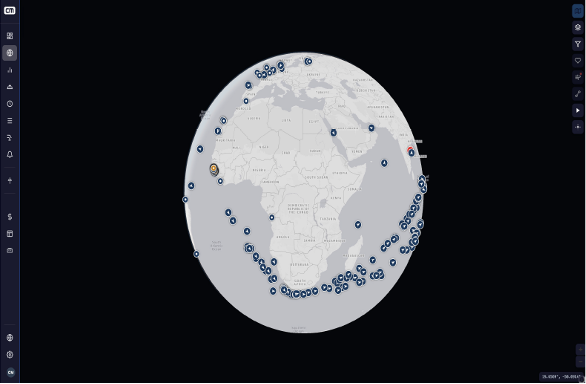
Global tracking of bauxite vessels. Source: CM Group (copyright)
China is the largest producing country for primary aluminium, so the demo highlighted flows of bauxite and alumina into China. China, for example, currently imports 75% of its bauxite from Guinea, 20% from Australia, and 5% from the rest of the world. Once smelted into primary aluminium, two-thirds of China’s domestic production is now sold as liquid metal straight to semi-fabricators within thermal trucking distance.
Alan noted that bauxite is not actually a commodity as it is not fungible – ore grades differ widely and refineries are usually tailored to specific mine’s inputs. This makes bauxite tracking easier. By contrast, alumina is a commodity and can be subject to swaps traded during physical transport, introducing more complexity. However CM Group are currently working on this as stage 2.
The demo highlighted access to layers of data from vessel movements, insights into stockpiling and response to fuel prices, visibility down to the level of each mining tenement on the database maps, and company to company flows visualised through Sankey diagrams.
From ASI’s perspective, this highlights the opportunity for further data connections, including linking to ASI Certifications as an additional map layer, and potential links to remote sensing to show land clearing around rehabilitation in mining licences.
Stepping back, there’s a powerful load of data: how could we distil relevant insights for different kinds of ASI members? And what data and commercial arrangements can best support this?
What’s next?
ASI and CM group will continue to scope out collaboration opportunities, particularly to support ASI members due diligence work. This includes potential for an additional subscription-type model.
One of our goals for the webinar was to gauge how much interest there might be in what CM Group has developed already; and whether it’s of interest to take this analysis to the third value step, that is flows from alumina to primary aluminium.
After seeing a little of what this work could offer, ASI is encouraging CM Group to continue their development work. ASI’s view is that to support criteria 9.8 in the Performance Standard, making the connections from bauxite, through alumina, to primary aluminium is critical to members due diligence.
In terms of next steps, ASI aims to:
- Support further collaboration between ASI and CM Group in this space
- Hold a ‘part 2’ webinar with ASI members, once CM Group’s work has progressed to the next stage.
SHARE THIS ARTICLE