How can downstream demand for aluminium drive upstream ASI engagement and Certification – and who benefits?
Downstream companies have considerable influence over how aluminium is produced and sourced further up the value chain – and can benefit from greater assurance about the aluminium they buy.
22 September 2026
Downstream companies have considerable influence over how aluminium is produced and sourced further up the value chain – and can benefit from greater assurance about the aluminium they buy. They can use that influence in two complementary ways: encouraging suppliers to engage with ASI and pursue Certification, and actively asking certified suppliers for ASI Aluminium. Together, these actions can support downstream companies’ responsible sourcing, due diligence and wider sustainability objectives, while expanding the network of certified suppliers and the flow of certified material through it.
A downstream company may be several steps removed from the mine, refinery or smelter where many of the environmental, social and governance impacts associated with its aluminium occur. But being further downstream does not mean being disconnected from those impacts. The choices companies make when selecting suppliers, setting procurement criteria and specifying the aluminium they want to buy can influence practices much further upstream.
A) What do downstream companies stand to gain?
For many companies, the starting point is assurance. Understanding how aluminium has been produced – and how environmental, social and governance risks are being managed upstream – can be difficult when supply chains involve multiple suppliers and processing stages.
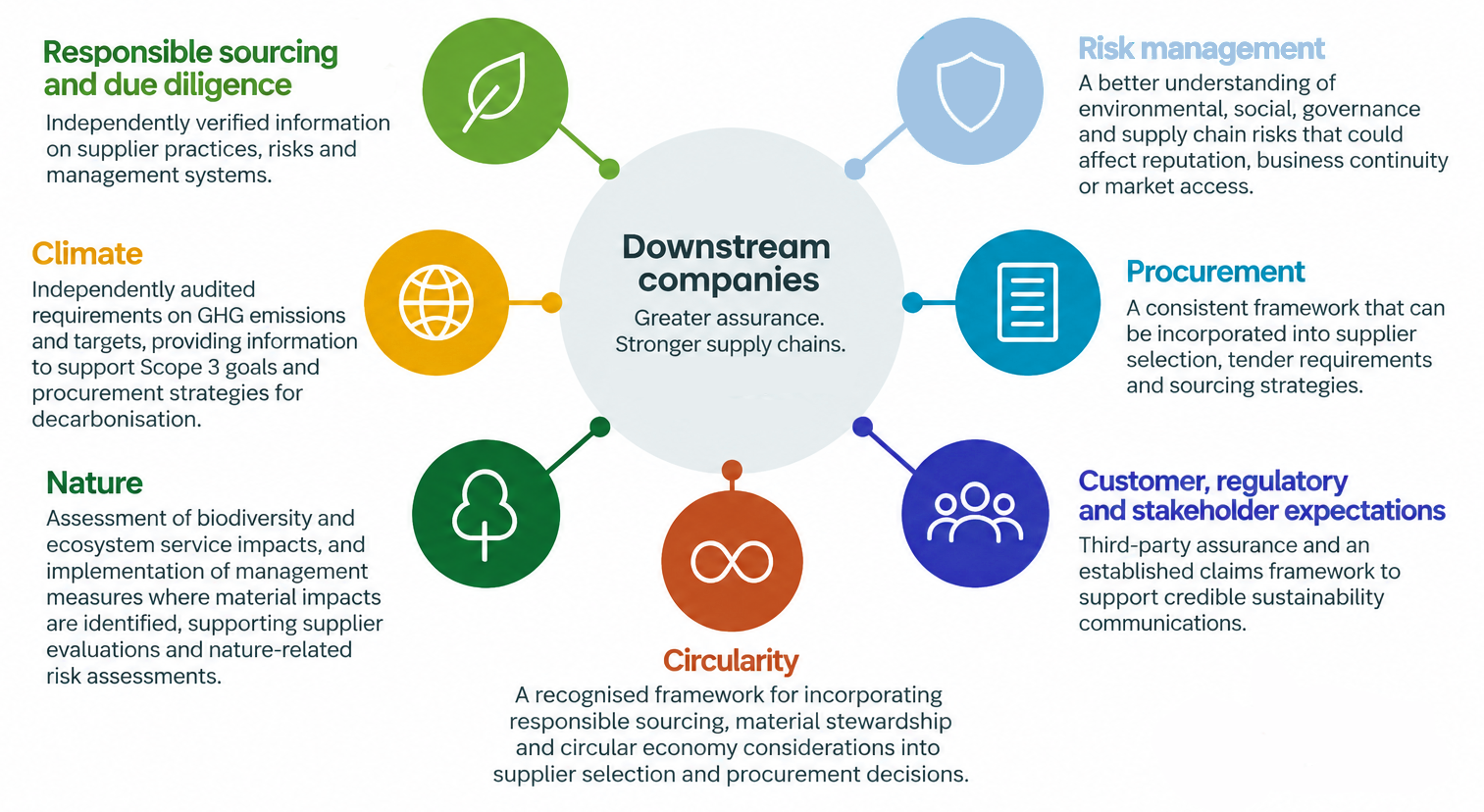 ASI Certification provides a common, independently audited framework that applies across the entire value chain, from bauxite mining and alumina refining through aluminium production, transformation and manufacturing. This means downstream companies can look beyond their direct suppliers and draw on a consistent set of environmental, social and governance requirements.
The Performance Standard addresses ESG criteria at Entity level, including supply chain due diligence and responsible sourcing, while the Chain of Custody Standard provides the framework for ASI-certified material to flow through certified entities at successive stages of the supply chain. For downstream companies, having ASI Certified suppliers in their supply chains can provide greater visibility and confidence beyond the direct supplier relationship, supporting responsible sourcing, due diligence and risk management. It also gives procurement teams a consistent framework that can be incorporated into supplier selection, tender requirements and sourcing strategies.
ASI Certification can also support wider corporate objectives. The Performance Standard’s climate requirements can provide information relevant to Scope 3 and decarbonisation strategies; nature requirements can support supplier evaluations and nature-related risk assessments; and circularity requirements provide a framework for incorporating material stewardship and circular economy considerations into procurement.
The business case is not simply about encouraging more Certification from suppliers. Engaging with ASI-certified suppliers and sourcing ASI Aluminium can also help downstream companies gain greater assurance about the aluminium they buy while supporting sustainability-related objectives they may already have. Most importantly, it also helps drive scale of impact beyond individual supply chains.
B) Two sides of downstream pull
Growing the flow of ASI Aluminium at scale requires two things: a connected network of certified suppliers and customer demand for the certified material that network can provide. Downstream companies can influence both.
Where suppliers are not yet certified, customers can encourage them to engage with ASI and pursue Certification, expanding the network through which ASI Aluminium can flow. Where suppliers are already CoC Certified, customers can ask them to supply ASI Aluminium, creating demand that puts that network to use.
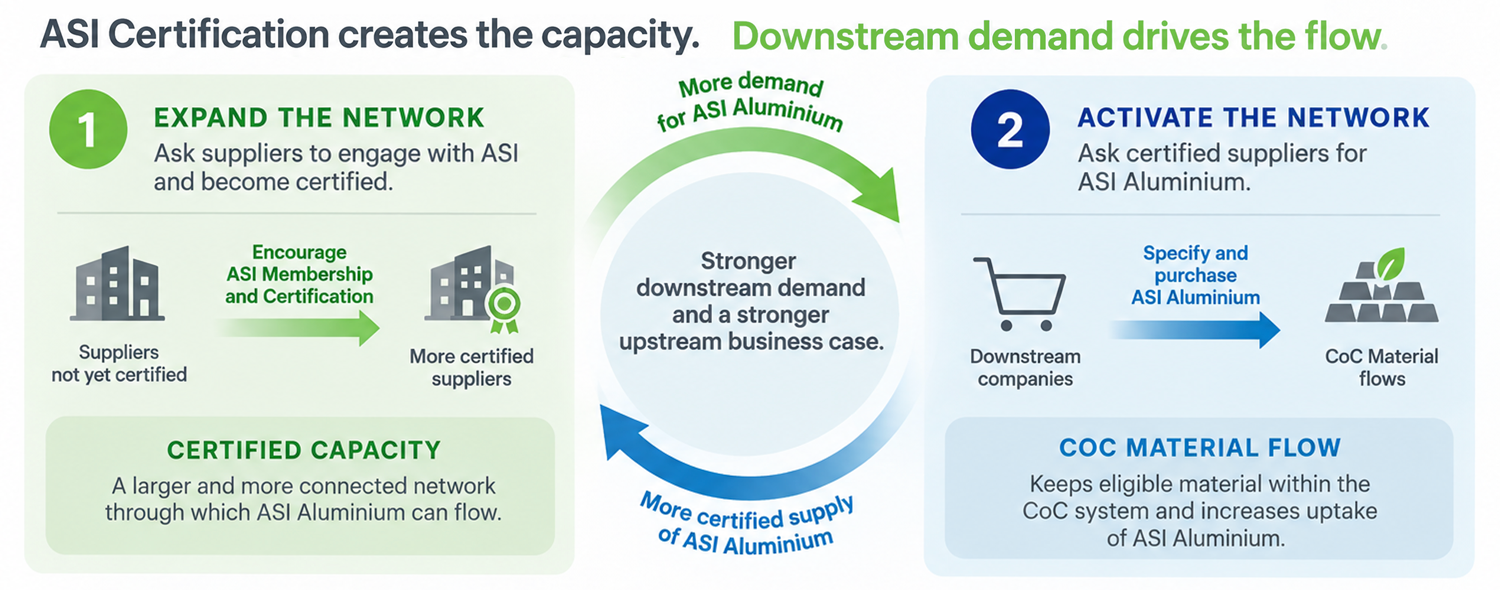 Certification creates the capacity for ASI Aluminium to flow, but does not by itself ensure that eligible material will be purchased as CoC Material. Without sufficient demand, available material may ultimately be sold without its CoC status. Lack of demand can ultimately lead to attrition from assurance programs – like any business investment, suppliers want to see that their customers value their efforts to implement responsible practices through standards.
A customer can start by asking its suppliers whether they are ASI Members, which operations are certified, whether they hold CoC Certification and whether they can supply ASI Aluminium. From there, the company can communicate a preference for certified suppliers, support suppliers on their certification journey, incorporate Certification into supplier selection – and, with CoC Certified suppliers, specify and purchase ASI Aluminium.
C) The signal travels upstream
Under the ASI Chain of Custody system, CoC Certification provides the framework for ASI-certified material to flow through successive stages of the value chain. This material is accounted for within the CoC system as CoC Material, including ASI Aluminium. Where suppliers want to offer CoC Material to their customers, they need to source eligible inputs and be CoC Certified. Demand for ASI Aluminium downstream can therefore create demand for both eligible material and Certification further upstream.
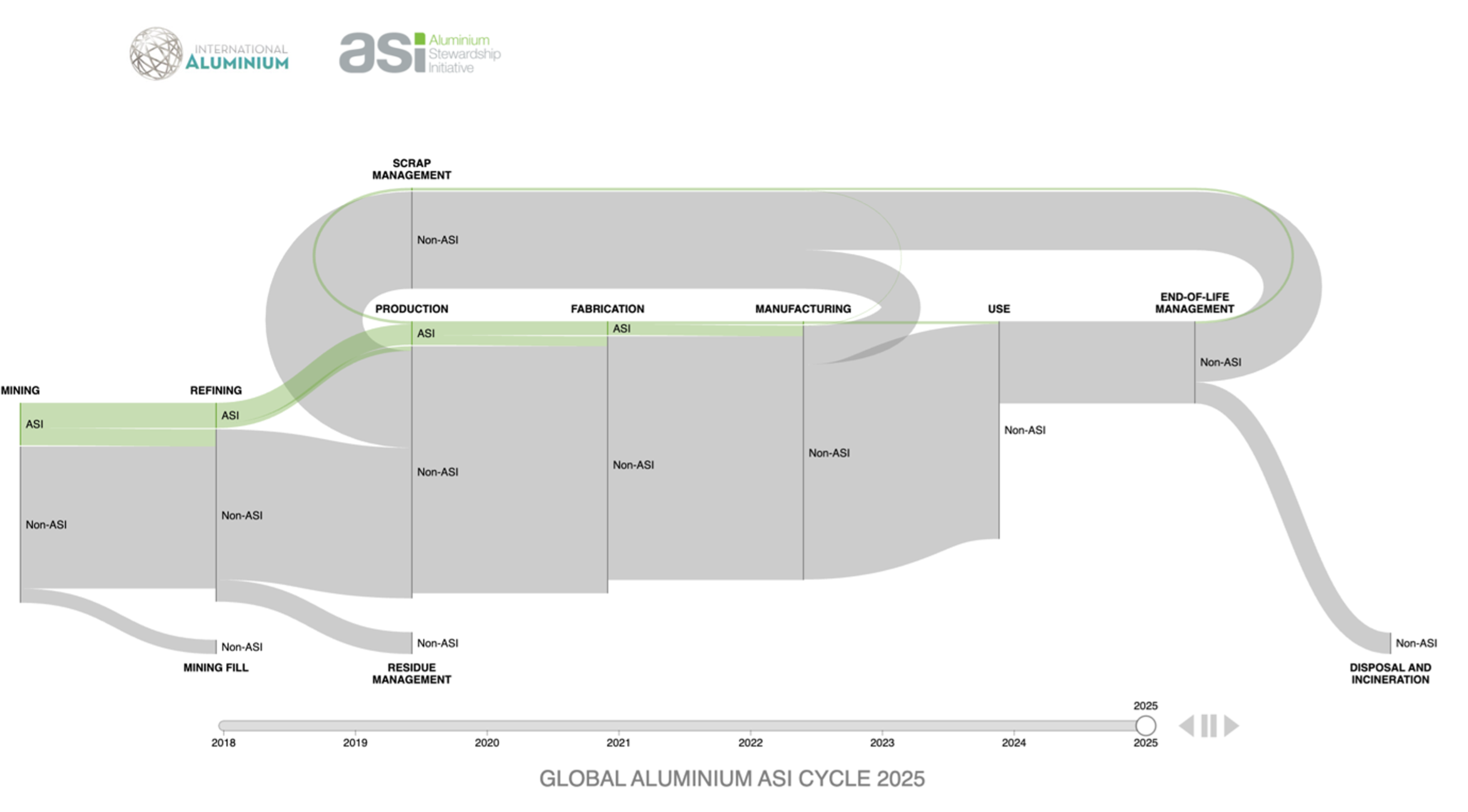 ASI CoC Material flows in 2025. The graphic illustrates how ASI Material moves through the global aluminium value chain – and where material leaves the certified flow. It highlights why both connected CoC Certified supply and downstream demand for ASI Aluminium are needed to maintain / expand CoC Material flows.
The CoC Material Flow data illustrate why both sides of the equation matter. Substantial volumes of ASI Material available upstream do not necessarily continue as ASI Aluminium through subsequent stages. When customers actively ask for ASI Aluminium, they provide a commercial reason for suppliers to source and sell material through the CoC system.
There is also potential for a multiplier effect across the value chain. Thousands of companies use aluminium downstream, while the number of actors becomes progressively smaller further upstream. Demand from many downstream users can therefore converge on a smaller pool of suppliers, strengthening the commercial signal for Certification and ASI Aluminium. Increased certified production upstream can, in turn, serve many downstream supply chains.
D) What does this look like in practice?
Several ASI Members are already demonstrating different elements of this approach.
Audi has incorporated Certification directly into procurement. Since 2020, CoC Certification has been mandatory for its flat-sheet suppliers, with the company working to extend the approach to other material categories. Audi has described combined Performance Standard and CoC Certification of suppliers as providing assurance of responsible ESG practices and acting as a supply chain risk-mitigation tool “all the way back to the mine”.
Ball Corporation illustrates how supplier engagement and demand for certified material can work together. Ball has asked its aluminium suppliers to become ASI Members and pursue Certification, while working towards sourcing 100% certified sustainable aluminium by 2030. In 2025, 34% of the aluminium purchased by Ball was ASI Aluminium, up from 27% in 2024.
Tetra Pak demonstrates how downstream ambitions can reach further upstream. Certification of alumina refining and bauxite mining operations in its sourcing is a key part of the company’s upstream targets for nature, with progress depending on collaboration with suppliers and ASI.
Mercedes-Benz in China offers another model, working with Yunnan Aluminium through the China Low-Carbon Aluminium Lighthouse Project to explore the use of ASI CoC-certified and low-carbon aluminium in automotive production.
Together, these examples show that downstream pull can take different forms: encouraging ASI Membership and Certification, working with suppliers on their certification journey, asking for ASI Aluminium, or incorporating Certification and certified material into procurement requirements.
E) What’s in it for upstream suppliers?
The benefits flow in both directions. A customer request may provide the initial motivation to pursue ASI Membership and Certification, but the value can extend well beyond that relationship.
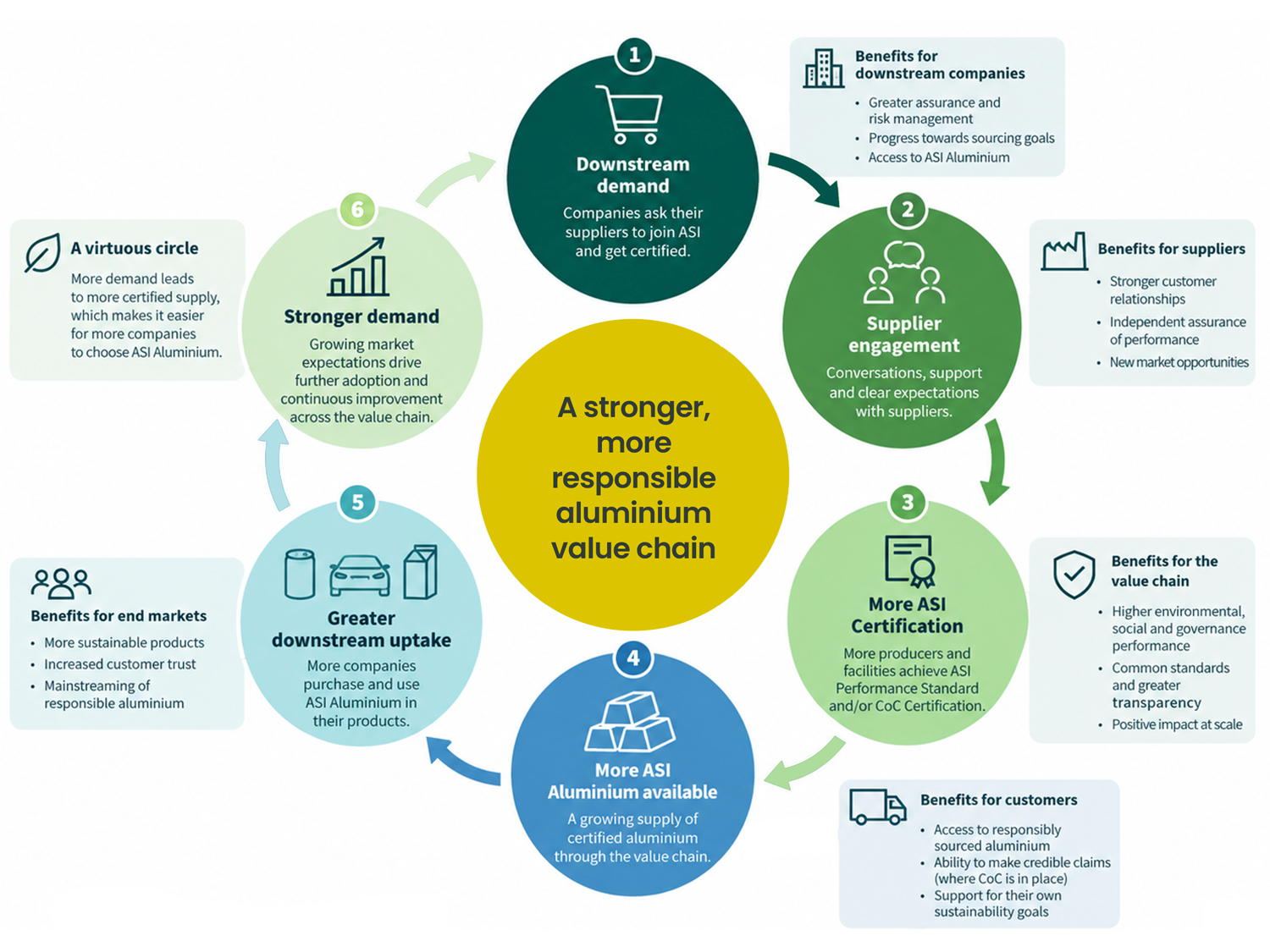 Certification can help suppliers improve performance on key sustainability issues, strengthen risk management and align their practices with regulatory, customer and stakeholder requirements. It can build trust, demonstrate sustainability credentials and enhance access to customers that prioritise responsible sourcing. As one ASI Member put it, Certification can effectively “cut the long story short”, providing a recognised and independently assured way of demonstrating sustainability performance.
There can be benefits inside the business too. Implementing the Standards can help strengthen internal processes, streamline operations and reduce waste, while ASI Membership provides access to learning, guidance and collaboration across the aluminium value chain. A demonstrated commitment to environmental and social performance may also support employee engagement and retention.
Once achieved, Certification is also not confined to one customer relationship. It can strengthen a supplier’s proposition to other customers – and as more customers actively ask for ASI Aluminium, strengthen the commercial value of maintaining CoC Material flows.
F) Start the conversation
Creating downstream pull can begin with a few questions:
- Are you already an ASI Member?
- Which of your operations are ASI Certified?
- Do you hold Performance Standard and/or CoC Certification?
- Can you supply ASI Aluminium today?
- If you are certified but do not currently supply us with ASI Aluminium, what would be needed to do so?
- If you are not yet certified, would you consider beginning the ASI certification journey?
Asking suppliers for ASI Certification expands the certified supply network. Asking for and purchasing ASI Aluminium puts that network to use. The two actions are different, but they are two sides of the same coin. Together, these demand signals can keep more material flowing through the CoC system and strengthen the incentive for ASI Certification further upstream.
SHARE THIS ARTICLE