Non-Conformances: Progress and trends across PS V2 and PS V3
Monitoring the progress of Entities closing Non-Conformances (NCs) after their first certification audit provides useful insights into certified Entities’ implementation of corrective actions over time, and offers a clear signal of how ASI Certification is working on the ground. It reflects how corrective actions are implemented, verified and embedded over time, strengthening practices within operations and across the aluminium value chain.
25 March 2026
Monitoring the progress of Entities closing Non-Conformances (NCs) after their first certification audit provides useful insights into certified Entities’ implementation of corrective actions over time, and offers a clear signal of how ASI Certification is working on the ground. It reflects how corrective actions are implemented, verified and embedded over time, strengthening practices within operations and across the aluminium value chain.
This analysis examines NC closure under ASI Performance Standard V2 (PS V2) and V3 (PS V3), highlighting key trends and outcomes.
ASI Performance Standard Certifications V2 and V3
NCs usually closed within the expected time via surveillance audits
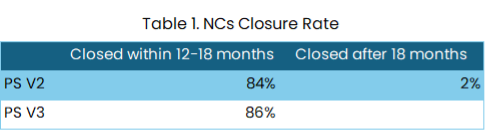
Progress tracking shows that, across both versions of the ASI Performance Standard V2 and V3, most NCs were closed within 12 – 18 months after identification. Many NCs are closed via surveillance audits (typically mid-certification cycle) as opposed to at the next re-certification audit. This demonstrates that corrective actions are being implemented and verified within a single certification cycle, which is within our timing expectations for the implementation of corrective actions.
Limited cases of downgrades
The data also indicates that downgrades remain relatively uncommon. Surveillance audits continue to identify new NCs, which is a normal outcome of ongoing monitoring. The identification of new issues alongside the closure of existing ones demonstrates that the assurance process is working as an active mechanism for maintaining compliance and supporting continuous improvement.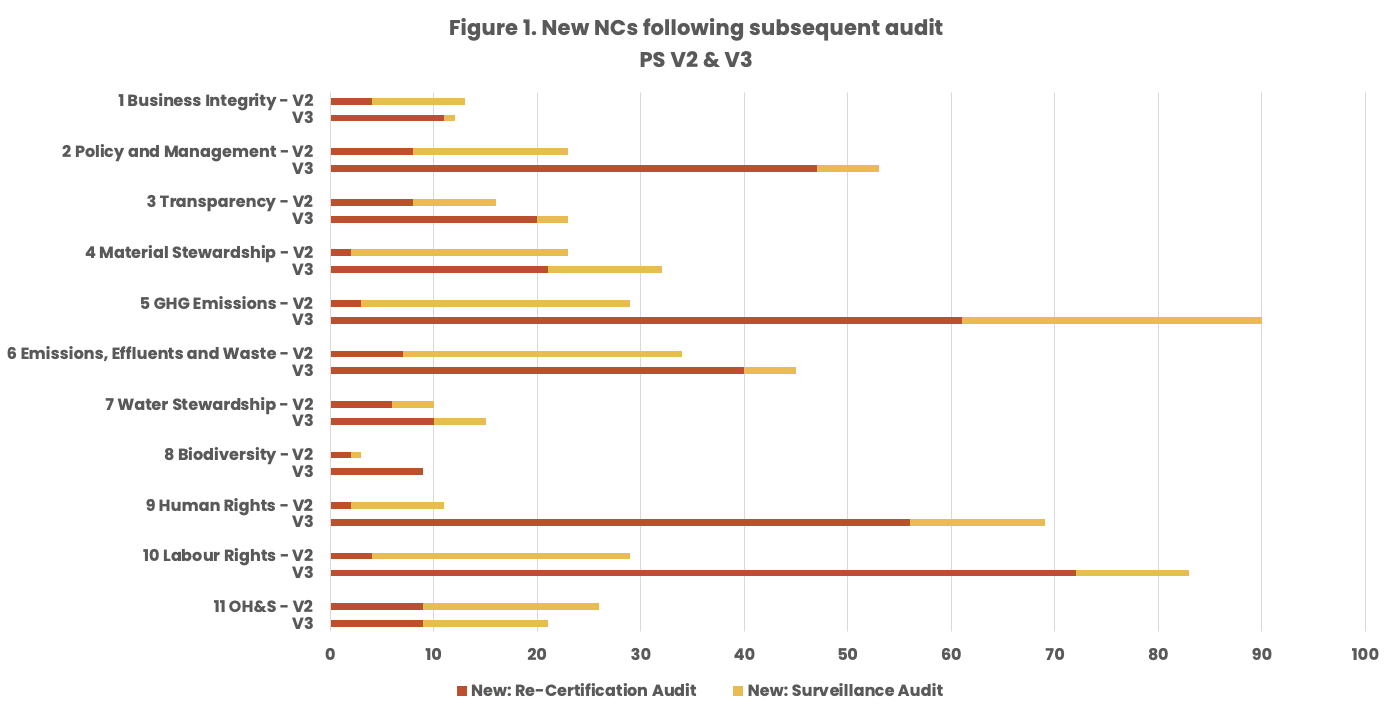
Key differences in the progress on NCs at subsequent audit between PS V2 and PS V3
Figure 2 shows how NCs identified under PS V2 and V3 progress at subsequent audit across different principles, depending on the type of audit (re-certification or surveillance). Re-certification results shown for PS V3 correspond to re-certification with Entities transitioning from V2 to V3.
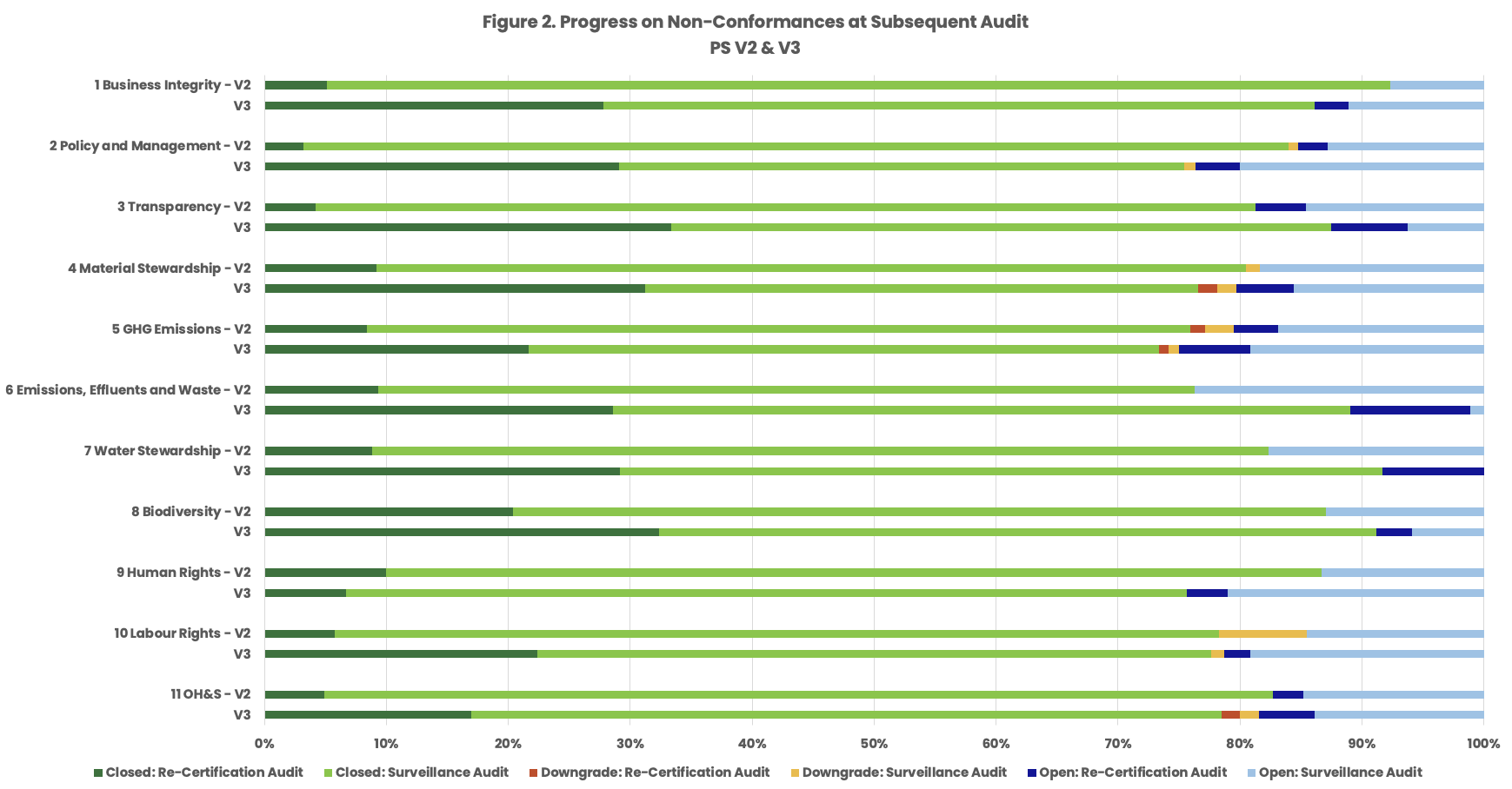
Under PS V3 there are more open NCs under Principles 1 Business Integrity, 2 Policy and Management, 4 Material Stewardship, 5 GHG Emissions, 9 Human Rights, 10 Labour Rights and 11 OH&S.
At the same time, the number of open NCs decreased under Principles 3 Transparency, 6 Emissions, Effluents and Water, 7 Water Stewardship, and 8 Biodiversity and Ecosystem Services.
Downgrades (i.e., where a conformance is reassessed as a non-conformance at a subsequent audit) remain rare and have been recorded under Principles 2, 5, 4 and 10. Under PS V3, Principle 11 has seen new downgrades noted at subsequent audits.
Taken together, this may indicate that Entities have matured in their management practices under some areas and this enables them to close NCs more quickly. For other criteria with expanded requirements under V3 some corrective actions require more time and effort to implement, due to the broader scope and increased level of detail of the requirements.
In addition, the identification of new NCs during subsequent audits reflects the important ongoing monitoring role of the certification process, to ensure that compliance is maintained over time. PS V3 appears to have higher counts of new NCs, which likely reflects the higher bar for compliance in many criteria in the updated standard.
Key insights
The data shows several trends across PS V2 and PS V3:
- Most NCs are resolved within the certification cycle, with 86% closed within 12-18 months under PS V3.
- NCs are usually closed during surveillance audits, demonstrating continuous follow-up.
- Downgrades (i.e., from a conformance rating to a non-conformance in a surveillance audit) remain rare.
- ASI Performance Standard V3 shows slightly more open NCs during surveillance, most likely reflecting V3’s more detailed requirements.
- New NCs continue to be identified during surveillance audits, demonstrating the ongoing monitoring role of the certification system.
Big picture outcomes
Taken together, the findings show that ASI Certification is operating as a dynamic system for continuous improvement rather than a one-off compliance check. The timely closure of most non-conformances, alongside the ongoing identification of new ones, reflects active monitoring and strengthening of management practices across certified Entities. The slightly higher number of open and newly identified NCs under PS V3 points to increased ambition and more detailed requirements, signaling deeper engagement with complex sustainability issues rather than weaker performance. At the same time, low levels of downgrades and faster resolution in some areas indicate growing maturity and capacity within the aluminium value chain.
Overall, the results demonstrate a credible and evolving assurance system that is supporting Entities to progressively improve and respond to rising expectations.
RELATED TOPICS:
data and researchnon-conformancesstandards implementation
SHARE THIS ARTICLE