Nature positive hub
Promote the use of the biodiversity mitigation hierarchy in management systems to protect ecosystems, habitats and species and to halt and reverse biodiversity loss.
At the core of our work is the ASI Performance Standard, which provides a framework for managing impacts on biodiversity and ecosystem services. ASI Performance Standard V3 (2022) promotes the use of the biodiversity mitigation hierarchy to protect ecosystems, habitats and species and to help halt and reverse biodiversity loss. Certified Entities are expected to assess risks, implement biodiversity action plans with targets, and review progress with stakeholders, alongside measures to protect ecosystem services, manage sensitive areas, and support responsible mine rehabilitation and closure.
Alongside this, the ASI Chain of Custody Standard supports responsible sourcing across the value chain. Complementary learning modules, webinars and case studies help translate these requirements into practice—building a clearer picture of what nature-positive aluminium looks like in action.
At its heart, the goal of the nature-positive sustainability priority is to halt and reverse the destruction of nature by 2030 with a full recovery of a resilient biosphere by 2050.
Watch: Nature Positive essentials
Start here for a practical overview of what nature-positive action means for business, governments and ASI. This webinar explores why nature-related impacts and dependencies are becoming as important to understand as climate impacts, how emerging frameworks are shaping expectations for companies, and why biodiversity, ecosystem services, climate, water and human rights need to be considered together. It also connects the broader nature-positive agenda with ASI’s role in supporting responsible practices across the aluminium value chain through its Standards, Chain of Custody approach, learning resources and ongoing standards revision work.
Nature Positive aspects of the ASI Performance Standard
Key elements
- Biodiversity and ecosystem services risk and impact assessments
- Development of biodiversity action plans, with time-bound targets, in consultation with stakeholders
- Regular review of action plans, targets and progress
- For priority ecosystem services, implementation of measures to increase resource efficiency
- Maintenance of access to priority ecosystem services and retention of their values and functions.
- Implementation of strategies to prevent introduction of alien species
- “No go” commitment in World Heritage Properties
- Implementation of management plans specific to operations co-located with protected areas and restrictions on mining where specific criteria are not met.
- Good practice for bauxite mine rehabilitation, including closure planning, financial provisioning, consultation and co-operation with stakeholders, and progressive rehabilitation of disturbed areas
- Public disclosures of plans, progress and data-driven reporting
- The wide scope of issues in the ASI Performance Standard ties nature-positive action in with climate change and human rights
- The ASI Chain of Custody Standard provides a mechanism to support responsible sourcing
The ASI Performance Standard V3.1 (April 2023) defines 62 environmental, social and governance principles and criteria, with the aim to address sustainability issues in the aluminium value chain.
Projects
ASI launched the Indigenous Peoples Mine Closure and Rehabilitation Project, beginning with a hands-on training programme from 26 January to 14 February 2025 at the Gulkula mine, in the Northern Territory of Australia — home to the world’s only Indigenous-owned bauxite mine. Seven Indigenous participants from Australia, India, Suriname and Ghana, along with three ASI Secretariat staff, took part in the “train-the-trainer” initiative.
Members of ASI’s Indigenous Peoples Advisory Forum (IPAF) have noted that conventional impact assessments often overlook the value of Indigenous knowledge and experience.
The Indigenous-led Participatory Cumulative Impact Assessment (IPCIA) offers an alternative approach, placing Indigenous knowledge and livelihoods at the centre of environmental and social evaluations. Developed by the Protect Sápmi Foundation based on over twelve years of experience with Indigenous communities in Sápmi, the methodology assesses cumulative impacts of development on traditional ecosystem services.
With ASI’s support, the IPCIA method was updated and translated into English in 2023, and is now available on the ASI website.
In addition, ASI and IPAF support has enabled testing of the IPCIA methodology in India in 2022/23 and Australia (short video) in 2024-25, including the active participation of an expert technical adviser and mentor for the projects.
Partnering with the University of Sunshine Coast and The Nature Conservancy on a study on mitigating the impacts of mining on ecosystem services (ES), in a region rich in both natural capital and culture – Western Cape York Peninsula in northern Australia. Activities include identifying the ES that are most valued by Indigenous communities; mapping the distribution of these services, including plants that have significant cultural value; and comparing them to areas currently protected from mining operations.
Working with KLIM to support the Indigenous communities in the Lower-Marowijne region of Suriname, an area subject to bauxite mining for nearly 100 years to develop an environmental and education project for the protection of their territorial lands.
Documents and reports
DOWNLOAD
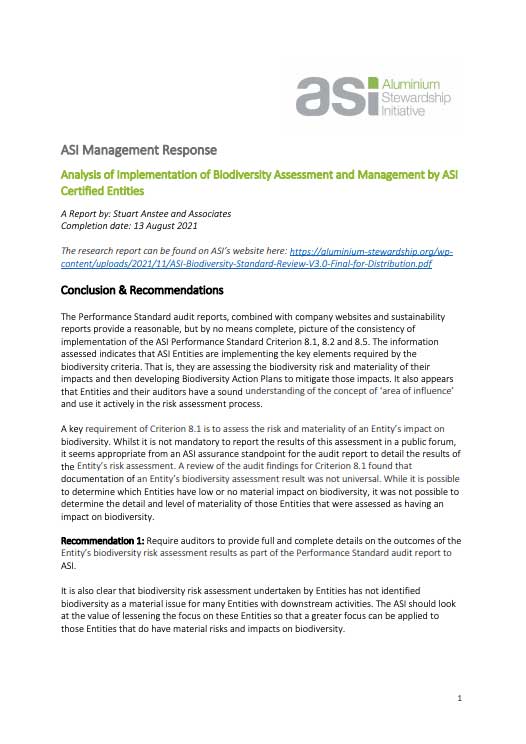
DOWNLOAD
Learning modules
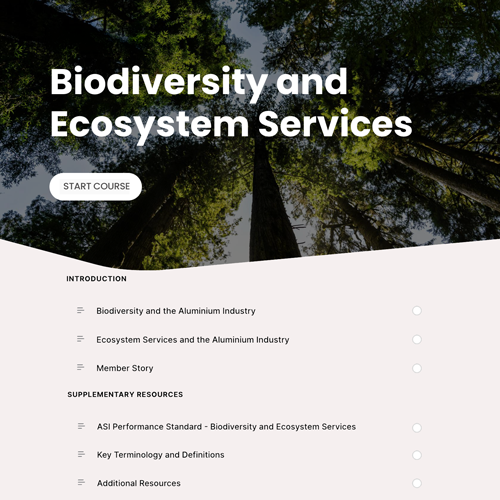
A sector-specific look at how the aluminium value chain depends on—and impacts—nature, tailored to the aluminium context and grounded in ASI’s approach.
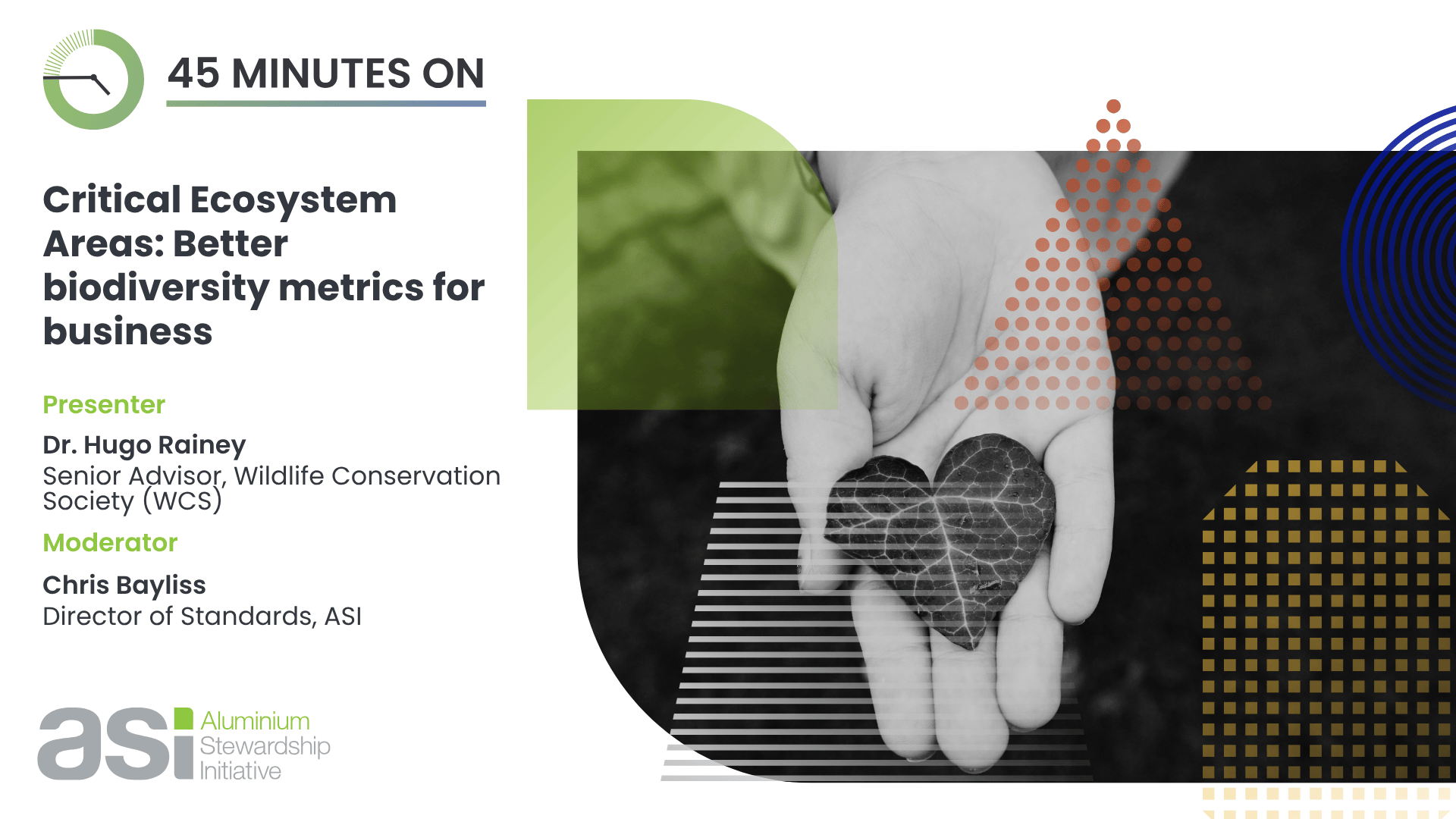
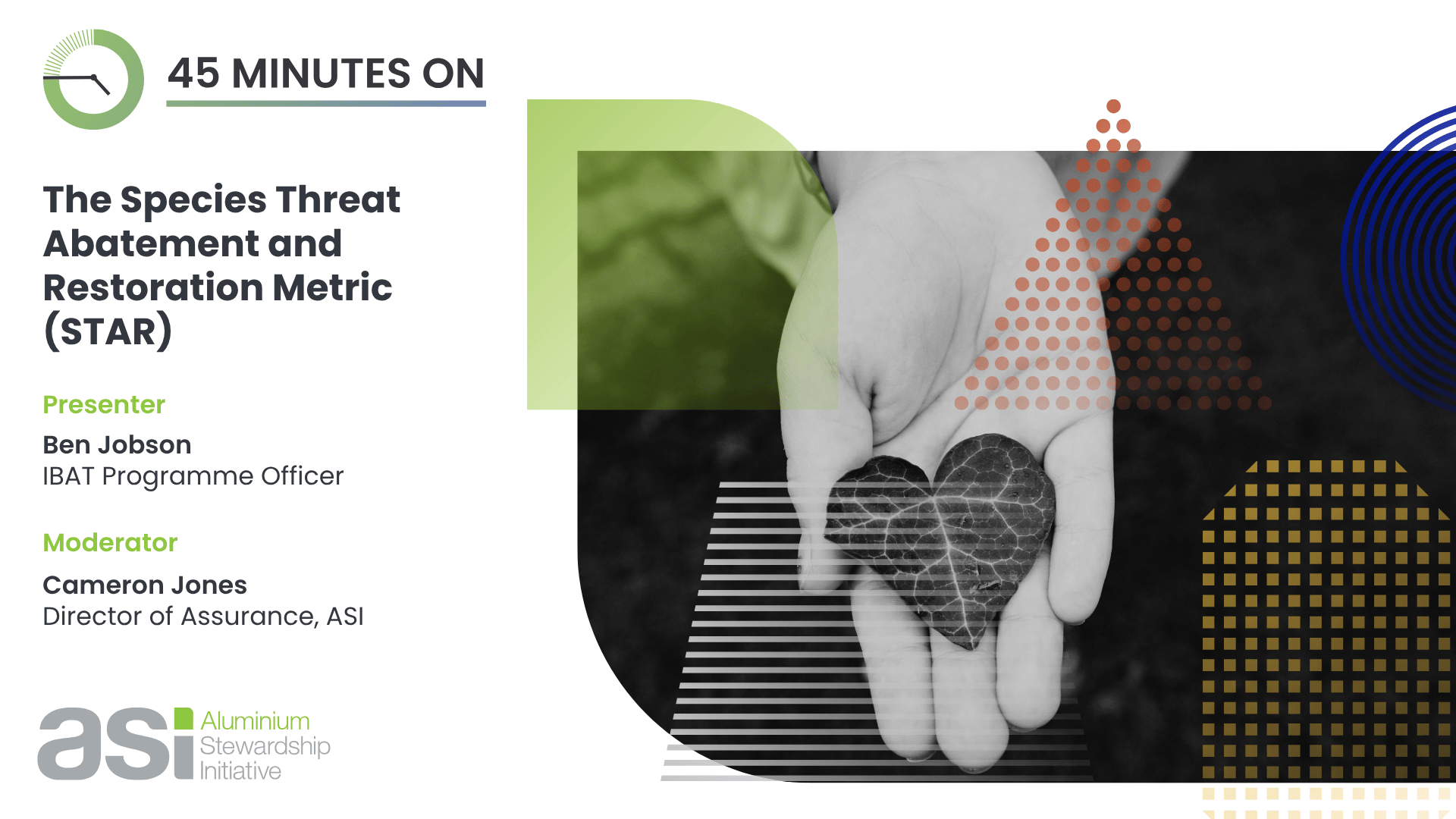
Webinars and Videos


Nature Positive/Biodiversity articles and stories
Restoring, protecting, improving, building capacity: ASI and its Members’ Nature-Positive Impact
ASI’s work in the nature space is helping drive measurable action across the aluminium value chain.
Building Stronger Standards: Water Stewardship and Gender in the Draft PS V4
As the public consultation for the draft ASI Performance Standard Version 4 (PS V4) is underway, we invite stakeholders to participate in shaping this next phase of responsible and sustainable practices for aluminium. To support this process, we are highlighting selected topics in the draft Standard to help stakeholders more easily understand the proposed changes, compare them with the current requirements, and form an informed view as they prepare their feedback.
Applying the mitigation hierarchy: Biodiversity actions across ASI-Certified Entities
An analysis of 50 Entities conforming to Criterion 8.2 of ASI’s Performance Standard V3 reveals how long-term commitments and collaboration are driving tangible biodiversity outcomes. Read how ASI members are turning the mitigation hierarchy into action.
RELATED TOPICS:
SHARE THIS PAGE: