Diverse voices and practical experience shape discussions in new Mine Closure and Rehabilitation Working Group
A new Working Group on Mine closure and rehabilitation has begun to tackle key issues in this important area of focus in the revision of the ASI Performance Standard.
21 September 2026
Mine closure and rehabilitation has emerged as an important area of focus in the revision of the ASI Performance Standard, reflecting its significance for Indigenous Peoples and local communities, nature and biodiversity, and the long-term social and environmental outcomes of mining.
The groundwork for this focus began before the Standards Revision, including through an ISEAL-supported project that explored mine closure and rehabilitation in Australia, Suriname, Ghana, Guinea and India. This work helped highlight both stakeholder interest in the topic and the need to strengthen how it is addressed.
From the outset of the revision process, ASI identified several goals for the new Performance Standard: strengthening expectations and transparency around mine closure and rehabilitation; increasing the involvement of Indigenous Peoples and affected communities; and incorporating more outcome-based criteria. These ambitions resulted in substantial changes in the first draft of Performance Standard V4 released for public consultation.
Feedback during the consultation showed that the subject warranted deeper discussion. Mine closure involves complex and sometimes competing considerations: regulatory requirements, community aspirations, biodiversity and nature-related goals, and what is technically achievable at individual mine sites. In response, ASI established a dedicated Mine Closure and Rehabilitation Working Group to help further refine the proposed requirements in the Standard, so that they are both ambitious and workable.
The response to the call for participation has been encouraging. The first Working Group meeting brought together representatives from seven bauxite mining companies and eight civil society and Indigenous Peoples Advisory Forum organisations or representatives. In total, 21 participants joined from five countries across four continents, supported by French and Portuguese interpretation. The group has also attracted several highly experienced practitioners who had not previously been directly involved in the Standards Revision process, bringing additional expertise and perspectives into the discussion.
The Working Group is now exploring some of the most challenging questions around responsible mine closure. These include how closure objectives and post-mining land uses should be established; what good rehabilitation should look like and how progress should be measured; and how long rehabilitation should be monitored and managed. The group is also considering how biodiversity objectives such as no net loss and net gain can be addressed alongside regulatory requirements, community priorities and site-specific realities.
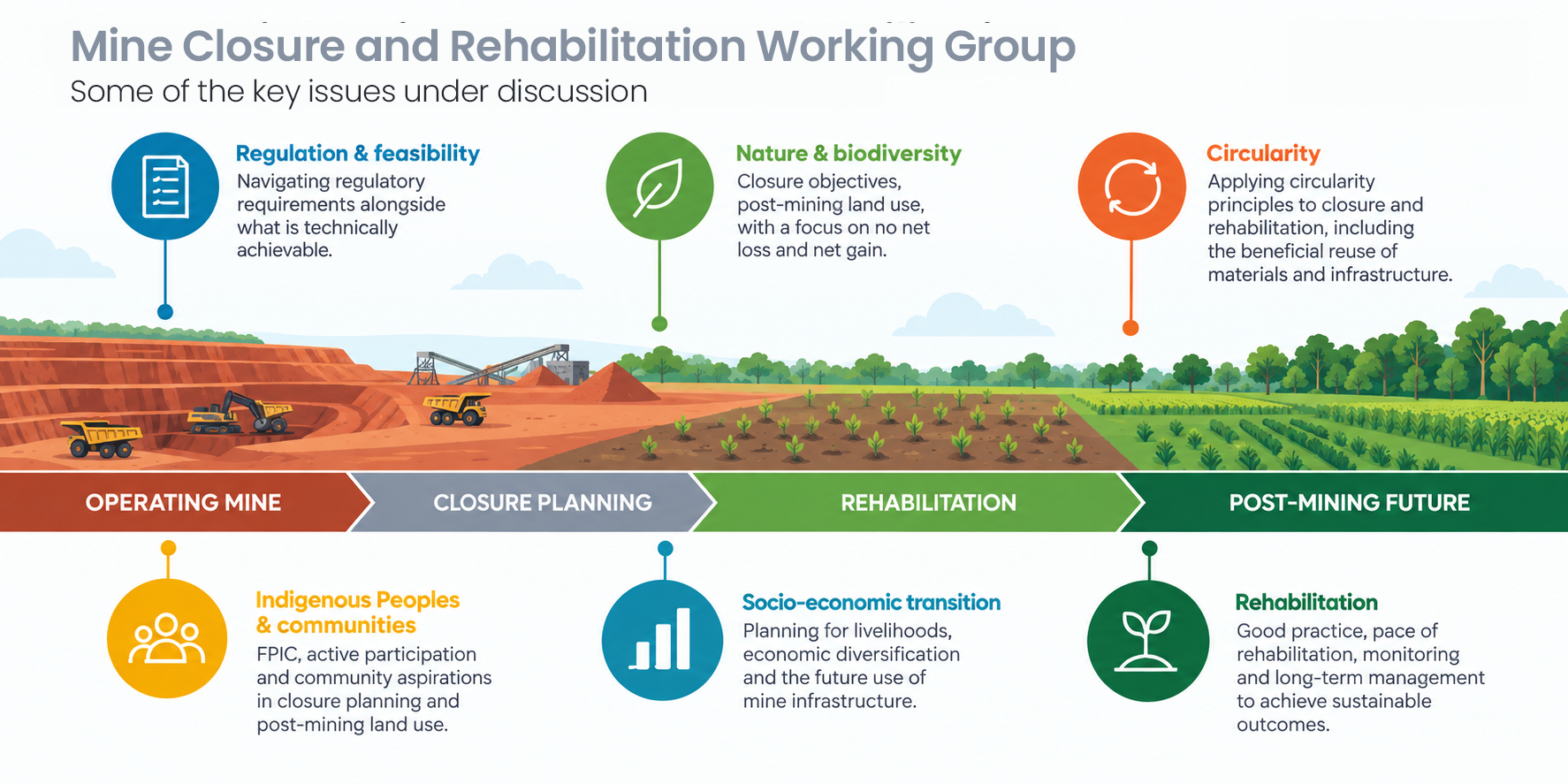 A particularly important area of discussion is the role of Indigenous Peoples in closure planning. Indigenous Peoples have consistently identified this as a priority for ASI, and it was strongly reaffirmed through the IPAF-led community consultation process. The Working Group is examining how Free, Prior and Informed Consent (FPIC) should apply to closure planning where Indigenous Peoples are present, and how the revised Standard can support meaningful involvement that goes beyond consultation alone.
Other areas under consideration include well-planned socio-economic transitions, including the future of mine infrastructure that communities use or may wish to use after closure, as well as the application of circularity principles.
These are complex issues without simple, one-size-fits-all solutions. Bringing together mining practitioners, civil society and Indigenous Peoples provides an important space to work through different perspectives and practical realities as the next draft of the Performance Standard takes shape.
The Mine Closure and Rehabilitation Working Group remains open to new participants. ASI Members and other stakeholders with relevant expertise or perspectives are encouraged to get involved or contact the ASI Secretariat to contribute to the discussion.
RELATED TOPICS:
25-27 revisionbauxite mine closuremine rehabilitation
SHARE THIS ARTICLE