ASI Standards Revision consultation receives strong global engagement
ASI’s first public consultation on the draft PS V4 and CoC V3 has generated more than 500 consultation responses and almost 1,600 individual qualitative comments
20 May 2026
ASI’s first public consultation on the draft PS V4 and CoC V3 has generated strong engagement from across the aluminium value chain and broader stakeholder community, with more than 500 consultation responses and almost 1,600 individual qualitative comments received during the 72-day consultation period running from 17 February to 30 April 2026.
 Feedback was received from industry representatives, civil society organisations, labour unions, auditors, associations, affected communities and other stakeholders through a combination of online surveys, written submissions, webinars and targeted engagement activities. ASI also worked through the Indigenous Peoples Advisory Forum (IPAF) to facilitate dedicated consultation sessions with Indigenous Peoples and affected communities in multiple countries, supported by translated materials and targeted questionnaires.
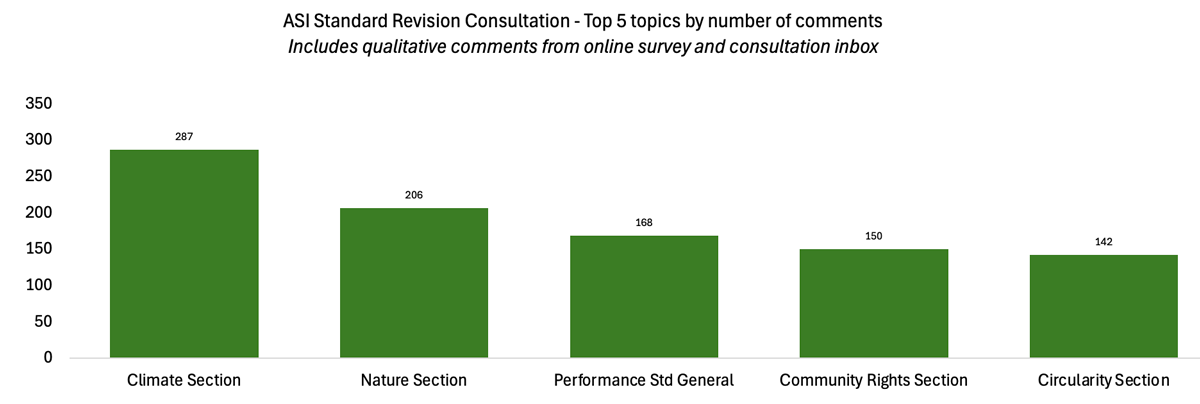
Consultation feedback showed broad support for the proposed structural changes in PS V4, including the reorganisation of principles, separation between criteria and requirements, and greater focus on materiality. While there was general support for the concept of leading practices and differentiation, respondents had many different opinions on how to integrate leading practices, and more refining is needed. Climate-related topics emerged as the single largest area of feedback, accounting for nearly 20% of all charted consultation comments. The strong focus reflects the central importance of energy, emissions and decarbonisation pathways to the aluminium sector, particularly amid ongoing market, technology and energy transition challenges.
Many industrial stakeholders expressed concern that some proposed climate-related requirements and emissions reduction expectations may not yet be practically achievable within current technology, energy and market constraints, while civil society stakeholders called for stronger ambition and clearer alignment with global climate goals. Respondents also provided detailed feedback on proposed requirements relating to working hours, living wages, smelter thresholds, community benefit agreements and the management of legacy impacts.
Feedback on the proposed streamlined certification approach for downstream Entities was mixed but constructive. Many respondents supported the concept as a way to improve accessibility and participation for downstream companies, while others cautioned that any simplified pathway would need to maintain the credibility and robustness of the ASI system. Some stakeholders also emphasised the importance of ensuring that future Standards evolution is accompanied by stronger market understanding and uptake of ASI Certification.
The consultation process also highlighted strong support from affected communities for strengthened requirements relating to community impacts, participation and rights protections. Across the consultation, stakeholders consistently emphasised the importance of balancing ambition, credibility, practicality and regional applicability as ASI continues development of the next generation of its Standards.
Feedback on the proposed evolution of the ASI Chain of Custody model similarly highlighted differing perspectives across the value chain. Respondents appreciated the streamlining of the standard, but were divided across the three proposed options for evolving ASI’s existing mass balance approach, with a slight majority favouring a transition toward site-level mass balance. However, some stakeholders questioned whether alternative Chain of Custody approaches would deliver significant additional value compared to the current model, particularly if they remained mass balance systems rather than physical traceability models.
ASI is currently reviewing and analysing all feedback received, together with support from the thematic Working Groups and Standards Committee. These inputs will help inform the next phase of Standards drafting and a public summary of consultation input and responses is expected to be published in September.
To stay informed on the ASI Standards Revision process and future consultation opportunities, visit the ASI Standards Revision Hub.
RELATED TOPICS:
SHARE THIS ARTICLE