The transition to a low-carbon aluminium sector depends on credible data, practical implementation pathways and transparent measurement of progress.
ASI’s climate change research generates the evidence needed to support this transition—from improving greenhouse gas data quality and developing 1.5°C-aligned decarbonisation methodologies to tracking sector performance, evaluating certification outcomes and identifying emerging climate-related challenges. Together, these insights help Members and stakeholders understand where progress is being made, where further action is needed, and how responsible production can contribute to global climate goals.
Data & Research Insights
Delivering on 1.5°C alignment: Quantifying emissions reductions from ASI certified Smelters
This analysis quantifies the potential GHG emissions savings between 2021 and 2030 by smelters within ASI Entities fully implementing 1.5oC aligned emissions reduction pathways.
10 Years of ASI: ASI’s GHG emissions pathway methodology and calculation tool
The ASI GHG Pathways Method provides companies with a practical tool to develop, measure and disclose science-based decarbonisation pathways, consistent with the requirements of the ASI Performance Standard (Version 3).
ASI is committed to transparency in reporting our Greenhouse Gas Emissions from business travel. We calculate and publish this data each year to demonstrate credibility, understand our travel-related impact, track trends over time, and support better decision making.
Tracking Progress: GHG Targets Among ASI Certified Aluminium Smelters
ASI is committed to a 1.5°C-aligned future. Certification data shows improvements in GHG Target setting performance among currently certified smelters since 2020.
D&R Insights: CO2 emissions: Certified vs. non-certified assets under the ASI Performance Standard
Reducing the aluminium sector’s emissions in line with a 1.5°C warming scenario is one of ASI’s long-term goals. In February 2024, ASI published an ASI Entity-Level GHG Pathways Method for ASI Entities to support them in determining 1.5°C aligned GHG Emissions Reduction Pathways.
D&R Insights: Land requirements for energy production for aluminium smelters certified under the ASI Performance Standard
Decarbonising energy production – a requirement of Performance Standard Principle 5 – has land use implications. Land-use changes for development can have significant environmental and social impacts.
D&R Insights: CO2 emissions from assets certified under the ASI Performance Standard
The latest IPCC Synthesis Report reinforces the urgency of climate action required to keep warming to 1.5°C. Reducing the aluminium sector’s emissions in line with a 1.5°C warming scenario is one of ASI’s long-term goals. What does the data show for decarbonisation of alumina refining, aluminium smelting and aluminium rolling processes from 2012 to 2022?
Under a 1.5 degree scenario, the aluminium sector must reduce its GHG emissions from over a billion tonnes of CO2e to around fifty million tonnes by 2050. This is less than one-twentieth of current emissions.
Analysis of 2020-2021 GHG Emissions disclosures by ASI Certified Entities reveals data quality improvement with mixed overall performance
M&E Insights, August 2021 Following an inaugural study carried out in 2020, ASI has today published a report which analyses greenhouse gas (GHG) emissions and energy use data disclosures by ASI Certified Entities with certification periods covering April 2020 to March 2021. The study, which reveals an improvement in data quality but mixed overall performance, […]
Data & Research related publications: Climate Change workstream
This follow-up study provides very useful insights in the energy use and GHG emissions reporting and disclosures of ASI Entities, energy use and GHG emissions comparison across ASI aluminium supply chain activities, from bauxite mining to downstream activities. DOWNLOAD
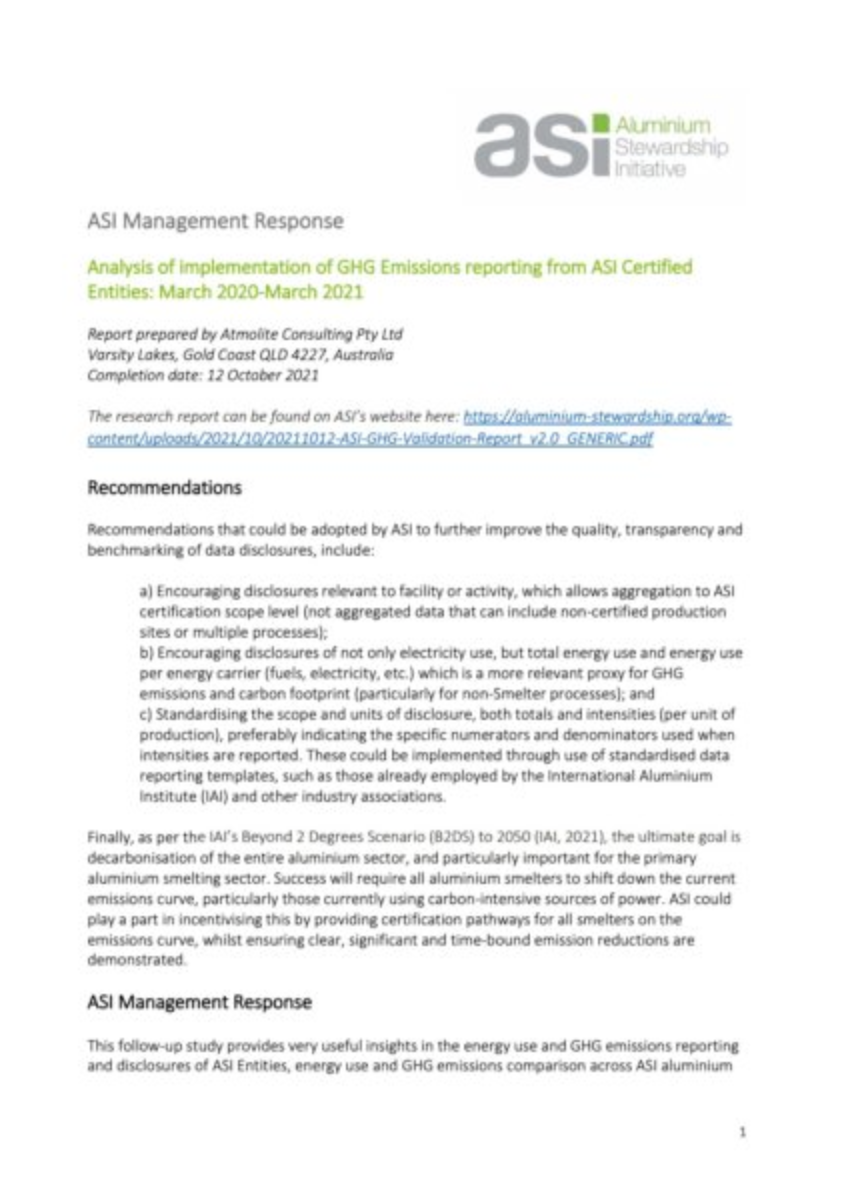
ASI's response to the Analysis of implementation of GHG Emissions reporting from ASI Certified Entities: March 2020-March 2021 update report. DOWNLOAD
This outcome evaluation provides useful insights into the challenges facing ASI’s Members and Entities in adopting a consistent, accurate and complete approach to GHG emissions reporting and public disclosure. DOWNLOAD
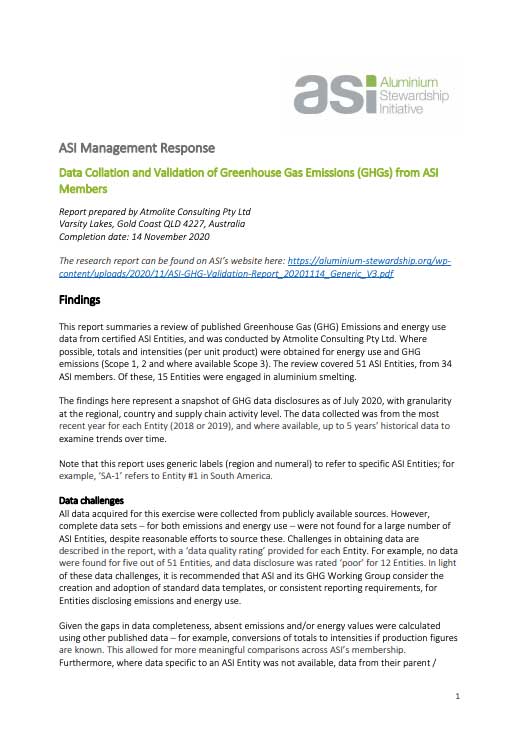
ASI response to the Data Collation and Validation of Greenhouse Gas Emissions (GHGs) from ASI Members report. DOWNLOAD
We use cookies on our website to give you the most relevant experience by remembering your preferences and repeat visits, NOT for advertising or contacting you. By clicking “Accept All”, you consent to the use of ALL the cookies. However, you may visit "Cookie Settings" to provide a controlled consent.
This website uses cookies to improve your experience while you navigate through the website. Out of these, the cookies that are categorized as necessary are stored on your browser as they are essential for the working of basic functionalities of the website. We also use third-party cookies that help us analyze and understand how you use this website. These cookies will be stored in your browser only with your consent. You also have the option to opt-out of these cookies. But opting out of some of these cookies may affect your browsing experience.
Necessary cookies are absolutely essential for the website to function properly. These cookies ensure basic functionalities and security features of the website, anonymously.
Cookie
Duration
Description
_GRECAPTCHA
5 months 27 days
This cookie is set by the Google recaptcha service to identify bots to protect the website against malicious spam attacks.
ARRAffinity
session
ARRAffinity cookie is set by Azure app service, and allows the service to choose the right instance established by a user to deliver subsequent requests made by that user.
ARRAffinitySameSite
session
This cookie is set by Windows Azure cloud, and is used for load balancing to make sure the visitor page requests are routed to the same server in any browsing session.
ASI-Cookie-IE
1 day
connect.sid
session
This cookie is used for authentication and for secure log-in. It registers the log-in information.
cookielawinfo-checkbox-advertisement
1 year
Set by the GDPR Cookie Consent plugin, this cookie is used to record the user consent for the cookies in the "Advertisement" category .
cookielawinfo-checkbox-analytics
11 months
This cookie is set by GDPR Cookie Consent plugin. The cookie is used to store the user consent for the cookies in the category "Analytics".
cookielawinfo-checkbox-functional
11 months
The cookie is set by GDPR cookie consent to record the user consent for the cookies in the category "Functional".
cookielawinfo-checkbox-necessary
11 months
This cookie is set by GDPR Cookie Consent plugin. The cookies is used to store the user consent for the cookies in the category "Necessary".
cookielawinfo-checkbox-others
11 months
This cookie is set by GDPR Cookie Consent plugin. The cookie is used to store the user consent for the cookies in the category "Other.
cookielawinfo-checkbox-performance
11 months
This cookie is set by GDPR Cookie Consent plugin. The cookie is used to store the user consent for the cookies in the category "Performance".
CookieLawInfoConsent
1 year
Records the default button state of the corresponding category & the status of CCPA. It works only in coordination with the primary cookie.
viewed_cookie_policy
11 months
The cookie is set by the GDPR Cookie Consent plugin and is used to store whether or not user has consented to the use of cookies. It does not store any personal data.
Functional cookies help to perform certain functionalities like sharing the content of the website on social media platforms, collect feedbacks, and other third-party features.
Performance cookies are used to understand and analyze the key performance indexes of the website which helps in delivering a better user experience for the visitors.
Cookie
Duration
Description
_gat
1 minute
This cookie is installed by Google Universal Analytics to restrain request rate and thus limit the collection of data on high traffic sites.
Analytical cookies are used to understand how visitors interact with the website. These cookies help provide information on metrics the number of visitors, bounce rate, traffic source, etc.
Cookie
Duration
Description
_ga
2 years
The _ga cookie, installed by Google Analytics, calculates visitor, session and campaign data and also keeps track of site usage for the site's analytics report. The cookie stores information anonymously and assigns a randomly generated number to recognize unique visitors.
_ga_0QVGSE7SHK
2 years
This cookie is installed by Google Analytics.
_gid
1 day
Installed by Google Analytics, _gid cookie stores information on how visitors use a website, while also creating an analytics report of the website's performance. Some of the data that are collected include the number of visitors, their source, and the pages they visit anonymously.
CONSENT
2 years
YouTube sets this cookie via embedded youtube-videos and registers anonymous statistical data.
Advertisement cookies are used to provide visitors with relevant ads and marketing campaigns. These cookies track visitors across websites and collect information to provide customized ads.
Cookie
Duration
Description
NID
6 months
NID cookie, set by Google, is used for advertising purposes; to limit the number of times the user sees an ad, to mute unwanted ads, and to measure the effectiveness of ads.
VISITOR_INFO1_LIVE
5 months 27 days
A cookie set by YouTube to measure bandwidth that determines whether the user gets the new or old player interface.
YSC
session
YSC cookie is set by Youtube and is used to track the views of embedded videos on Youtube pages.
yt-remote-connected-devices
never
YouTube sets this cookie to store the video preferences of the user using embedded YouTube video.
yt-remote-device-id
never
YouTube sets this cookie to store the video preferences of the user using embedded YouTube video.
yt.innertube::nextId
never
This cookie, set by YouTube, registers a unique ID to store data on what videos from YouTube the user has seen.
yt.innertube::requests
never
This cookie, set by YouTube, registers a unique ID to store data on what videos from YouTube the user has seen.